Where the water actually gets in
Roofs very rarely leak through the middle of a tile or a sheet. They leak at the joins, and the joins are where salt wind and leaf litter do their work. On the Northern Beaches the same handful of details account for most call-outs.
Flashings. Chimneys, skylights, parapet upstands and the junction where a lower roof meets a wall. On the coast the flashing lap is attacked from both directions: salt chews the metal and the sealant goes chalky, while onshore wind drives rain uphill into the lap under pressure that an inland roof never sees.
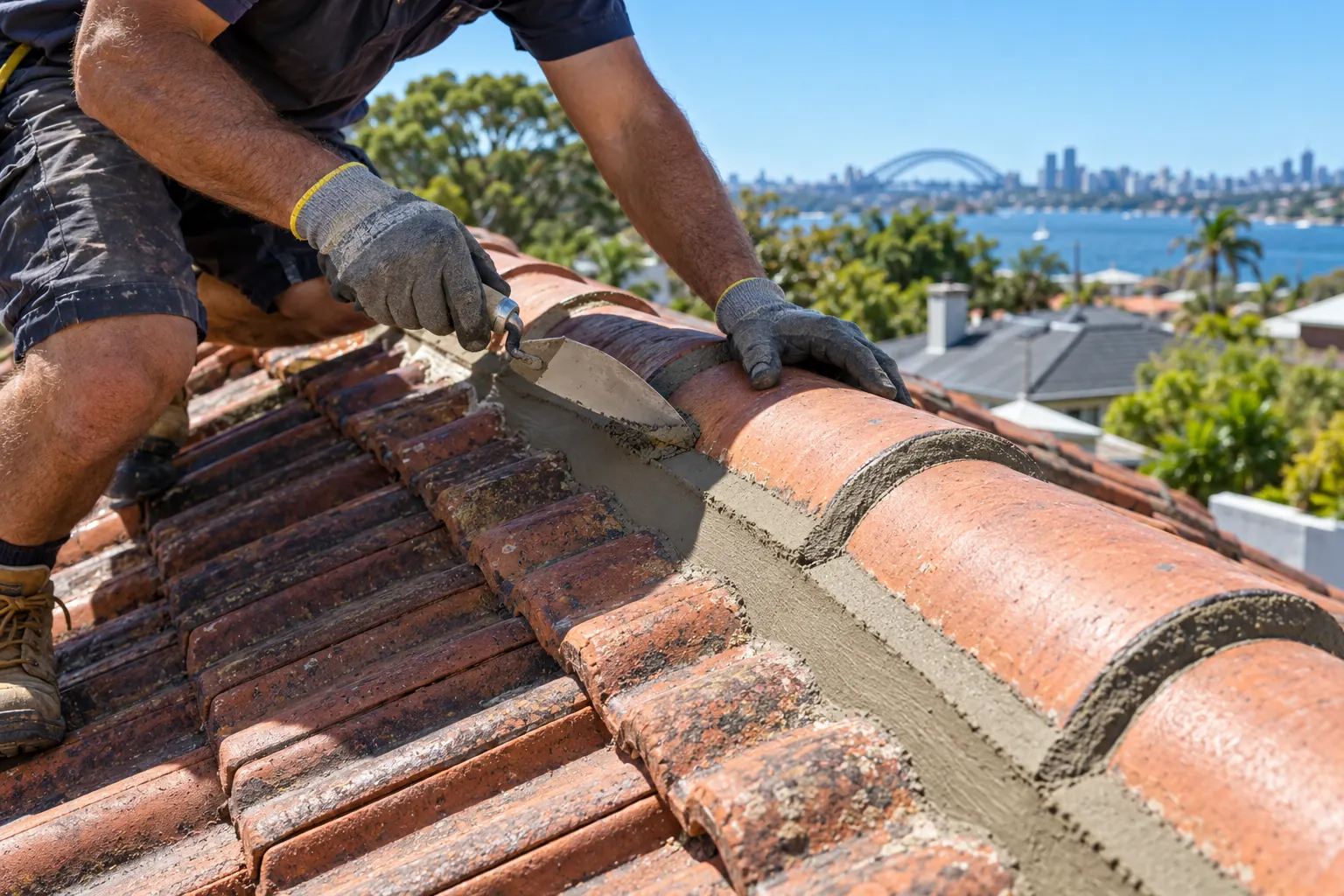
Ridge and hip capping. The pointing on a tiled roof cracks, lifts at the edges, then falls out in sections. Once the caps are loose, water tracks straight under them and into the roof space, often emerging well away from the ridge.
Valleys. Both for corrosion on the ocean side and for blockage on the bush side. A valley iron under angophoras at Belrose or Forestville can be holding a wet mat of leaf litter all winter, which dams water back under the tiles on both sides.
Fasteners and cut edges on metal roofs. This is the coastal signature. Rust appears first at the screw heads, at the cut ends of sheets, and anywhere the factory coating was breached during installation. The sheeting can still be sound while the things holding it down are not.
Call (02) 8000 1949 and describe what you have seen. The inspection is free and comes with a written list of findings.
The faults that repeat, suburb by suburb
What we find has a lot to do with where the house sits.
- Within a few streets of surf — Freshwater, Curl Curl, Dee Why, Collaroy, Narrabeen, Newport, Avalon Beach, Whale Beach, Palm Beach: corroded fixings, rusted gutter and fascia lines, flashing laps that have given up, and salt deposits sitting in sheltered spots that rain never rinses.
- Harbour and Pittwater frontage — Fairlight, Balgowlah Heights, Seaforth, Bayview, Church Point: marine exposure without the surf, plus steep blocks and heavy tree cover from the bushland reserves. Access is usually the complication.
- The Forest and the ridges — Frenchs Forest, Belrose, Forestville, Beacon Hill, Allambie Heights, Narraweena: leaf-packed valleys and gutters, ponding behind blockages, and tile roofs from the post-war subdivisions reaching the end of their pointing life all at once.
- The lagoon flats — Narrabeen, Warriewood, parts of Cromer and Manly Vale: ordinary roof faults made worse by volume, because when the drainage backs up, a small gutter fault becomes water through a ceiling.
Tile roofs and metal roofs fail differently
A concrete or terracotta tile roof is a water-shedding system that tolerates small faults until it doesn't. Tiles crack from foot traffic, tree limbs and age; the mortar bedding under ridge caps dries out and lets go; and where there is no sarking, there is nothing between a slipped tile and your ceiling. Tile repairs are usually about re-securing, re-pointing and replacing individual units — provided the tiles themselves still have life in them.
A metal roof is a sealed system that depends on its fasteners, laps and flashings. On the beaches the repair conversation is nearly always about corrosion: which screws are failing, whether the sheet ends have gone, whether the flashing can be re-formed or needs replacing, and whether the hardware that was originally used was ever rated for that address. We match replacement hardware to the exposure, which is covered in more detail on the metal and Colorbond page.
Low-pitch and parapet roofs on modern rebuilds are their own category. With very little fall, water sits rather than runs, so a blocked outlet or a lazy lap becomes a leak rather than a puddle. These need inspecting as drainage systems, not just as roof coverings.
What happens on the first visit
- A look over the whole roof, not only the area above the stain, because the entry point is usually uphill of the damage.
- Flashings, valleys, ridge line, fasteners, sheet ends, gutters and downpipes all checked individually.
- Roof space inspected where there is access, so the wet timber and the stained sarking can be traced back to the entry.
- Photographs of the faults, so you can see what we saw without climbing a ladder.
- A written quote listing what needs doing now, what can be left for a season, and the price of each.
If water is coming through a ceiling while we are talking, the first job is a make-safe to get the house dry — see storm and emergency repairs.

What a repair costs
No honest figure exists before someone has looked. What moves it:
- How far the fault has spread. A single lifted flashing is a small job. The same flashing after two winters of water into a batten is a bigger one.
- Access. A single-storey roof in Narraweena with a clear driveway is straightforward. A cliff-side block at Whale Beach, a split-level dropping toward Middle Harbour at Seaforth, or a Queenscliff street with no room for a scaffold all add set-up time.
- Pitch. Steep roofs need harnesses and more care, and that is time.
- Materials and exposure. Coastal-rated flashings and fixings cost more than inland hardware. On an oceanfront roof that is not an upsell, it is the difference between a repair that lasts and one you pay for twice.
- Matching materials. Tiles from a discontinued profile sometimes have to be sourced second-hand, which affects both price and timing.
When a repair stops making sense
There is a point on every roof where patching becomes the expensive option. The honest signals are: three or more separate leaks in different parts of the same roof; tiles that have gone porous and are holding water; ridge pointing failing along the whole length rather than in patches; and rust perforation across a broad area of sheeting rather than at a few screws.
At that point the choice is restoration if the tiles are still structurally sound, or full replacement if they are not. We will say which one applies and why, in writing, and we are happy for you to take that report to someone else for comparison.
Book the inspection
Free, no obligation, and you get the findings in writing either way. Call (02) 8000 1949 or send the form with your suburb and what you have noticed. We cover the whole Northern Beaches, ocean side and bush side.